

In Florida, trying to baptize an alligator in a retention pond gets you on the eleven o'clock news. Move to the Tennessee mountains and weep into a laptop over a hockey transaction, and somebody hands you a column. I am grateful nobody checked my references.
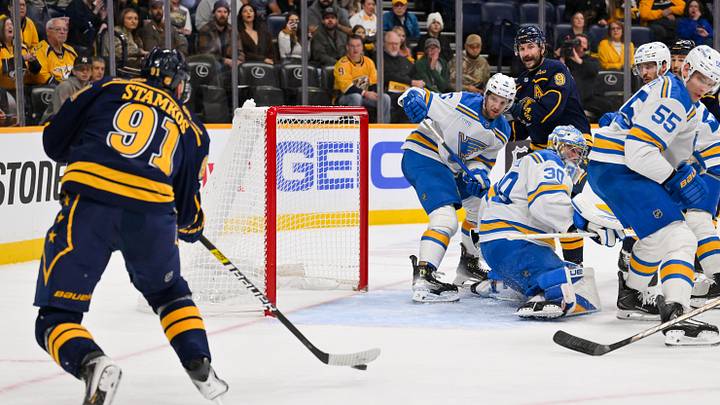
On July 1, 2024, Steven Stamkos signed a four-year contract with the Nashville Predators. I took it as a gift arranged for my personal convenience. I was already living in East Tennessee. My old Tampa captain had apparently studied a map, found me, and decided the neighborhood needed the help. To explain that, I have to go back to a flickering television in a house where nobody owned skates.
Picture a Clearwater living room back when the citrus groves ran deep and thick and the state ran on window units and bad decisions. My mother carrying a tuna noodle casserole with crushed potato chips baked on top, which in the America I grew up in was not a punishment but a Tuesday. And on the screen, impossibly, a sheet of white ice and a lean man in a white helmet with 99 on his back, doing things with a puck that looked less like sport than a card trick at a hundred miles an hour.
That was Wayne Gretzky. Where I grew up, ice was something that melted, fast. No skates in the house, no rink for a hundred miles, and I loved the game anyway, through the handful of nights a year it surfaced on cable, usually wedged between a wrestling broadcast and a man demonstrating a knife that could also saw through a shoe. I played goaltender in the driveway in sneakers with a tennis ball, on a cul-de-sac that dead-ended at a drainage canal with a resident alligator we had named Sir Chomp-a-Lot and did not entirely trust, on the grounds that Sir Chomp-a-Lot had never done one thing to earn it. There were limits to how far you chased a rebound.
A Florida boy and a borrowed game
On August 9, 1988, Edmonton traded Gretzky to Los Angeles for players, picks, and a pile of money, and even in my corner of Florida it made news for days. Watching grown men fight back tears over a transaction, I learned the first durable lesson this game ever taught me: your guy is not yours. He belongs to whoever owns him, and they can decide, in a room you never see, that it is time for him to go. I spent much of my life relearning that one in fresh formats, a fair number involving the word hurricane.
But that trade cracked the sport open. Gretzky in Hollywood turned warm-weather hockey from a punchline into box office, the league went chasing the crowds south, and in 1992 it reached my shore. The Tampa Bay Lightning were terrible enough to feel handmade, held together with duct tape and civic optimism. They played their first season at Expo Hall on the state fairgrounds, then moved into the ThunderDome, a domed stadium built for a baseball team that had not yet bothered to show up. They were ours.
They won a Cup in 2004, and in 2008 they drafted Stamkos first overall: 51 goals in his second season and 60 more two years after that, a one-timer you could see coming and still not stop. He broke his leg on a goalpost, which being inanimate declined to apologize, came back, and they made him captain. After years of almost, he did it, twice: back-to-back Cups in 2020 and 2021. Sixteen seasons, and he left in 2024 as the franchise's career leader in goals and points. I watched the draft pick become the captain while getting older myself, a development for which I also blame management.
You know, if you know this game, where this is going.
A city with teeth
Four years ago I packed up the salt, the humidity, and the specific knowledge of which gas stations sell boiled peanuts at midnight, and moved to a house on a hill east of Knoxville, where the water runs cold and there is not one honest grouper sandwich within three hundred miles of my door. I watched my team on a laptop in a cold room, not yet understanding where I had landed.
Nashville did not stumble into hockey. It dug hockey out of its own ground. In 1971 a crew digging the foundation of a downtown bank tower found a cave holding the 9-inch fang of a saber-toothed cat, and in 1997 the animal became the logo. Nashville performed an exhumation and put it on a jersey. Most marketing departments would have scheduled six meetings and settled on a bird.
And in 2007 the city had to prove in public that it wanted to keep the thing. Owner Craig Leipold's deal to sell the Predators to Jim Balsillie raised the prospect of a move to Hamilton, Ontario. The deal fell apart, and Nashville, which was not supposed to care about hockey, refused to let go. Fans rallied by the thousands and bought tickets, and a local group completed its purchase that December and kept the team home. Understand the degree of difficulty: a city that will deep-fry anything that holds still, in a state where ice is a garnish, looked a billionaire in the eye and said no. That is not fandom. That is a hostage situation the hostages won.
David Poile ran the place for 26 years and never got to lift the Cup, the great unfinished sentence of the sport, which Nashville has somehow turned into a party. Long before the 2017 Final it had built one of the loudest buildings in the league and taken up its working relationship with the catfish. That spring it turned the city gold and took Pittsburgh to six games. This is a fanbase that has been the thing left at the station, and it knows in its bones what to do when a cast-off turns up at the door.
They let him walk
In the summer of 2024, Tampa let Steven Stamkos walk out the door. He wanted to stay; the sides could not agree. The Lightning chose Jake Guentzel and a different place to put the money, and I understood the argument even as I wished a modest and highly localized plague on everyone who made it. The cap is a cruel and unsentimental accountant, but it does not sign the checks by itself, and the math does not care that a man gave your city 16 years and two parades. I reserve the right to be unreasonable for another decade, depending on the grouper situation. They carried him out to the curb like furniture, and I watched it happen from a mountain that suddenly felt a long way from home.
And then he signed in Nashville.
Sit with that. Of all the cities in the league, he landed three and a half hours west of the mountain town I had run away to, with the one franchise that knows from the inside what it is to nearly lose the thing it loves. I have never felt so thoroughly found by a professional athlete. Not by a woman, not by the IRS, not by the man who still calls my old Florida landline looking for Rhonda. By a hockey player. Nashville bought four years of a shot it believed could still change a game, and I took the signing personally, which was generous of me, considering nobody had asked.
The bounce-back
But this is not only a sentimental man weeping into his gravy. What he has done since he got here is the best part.
That first Nashville season I watched him the way you watch a toddler carry a full bowl of soup across a hardwood floor. The way you watch a groomsman get to his feet with no notes and three drinks in him. The way you watch the gas light come on forty miles from the nearest exit. Call it 27 goals, 53 points, respectable at a dinner party and alarming on an $8 million cap hit. Done. Cooked. A legacy signing aging like a carton of milk left in a July parking lot. The internet, which has never missed a chance to hold a funeral early, began sketching the eulogy.
And here was the newcomer, me, turning up to a city that has never won a Cup with three of my own in my back pocket, which is a bit like bringing a résumé to Thanksgiving dinner. Nobody asked, Phillips.
Then last season he scored 42. That was 15 more than the year before, 66 points, and he never needed to say a word of I told you so, which remains the most devastating way a man can be right. The milk, it turned out, was aging like bourbon. The part worth noticing is where the goals came from. His power-play total held at 14 both years; everything else more than doubled, from 13 to 28, over the same 82 games. The office in the left circle was still open, and he had started making house calls. Twenty-eight goals outside the power play will interrupt a good obituary.
This season he has gotten greedy. Through their November 21 win over Pittsburgh the Predators are 12-6-5 and fourth in the Central, and in 23 games my ancient captain has 12 goals and 12 assists, a 44-goal pace over the 84-game schedule. He is 36, past 600 career goals, in rooms with the names your grandfather talked about. Somewhere in Tampa an accountant is eating his Thanksgiving standing over the sink, and that seasons the gravy a little.
Roman Josi wears the C here. Filip Forsberg can make a goal look like a clerical matter. They named this team for an apex predator, then imported another one who hunts from the left faceoff dot. The power play can still resemble a group project the night before it is due. At least everybody knows who can finish the assignment.
A place at the table
People ask how a Lightning man ends up grateful at the Predators' table, and the best answer I have is Planes, Trains and Automobiles.
I am Neal Page: far from home, certain I have my life arranged, furious at every detour. Stamkos is Del Griffith, the enormous unasked-for presence who steers the rental car the wrong way between two semis and watches it catch fire, which is as fair a description of 27 goals on that cap hit as I can give. You're going the wrong way, I screamed at my laptop all winter. He still can't hear me.
You know how it ends. Del has no home to go back to, no table, nobody waiting. Tampa let Stamkos walk, and Nashville, a town that sat on that same bench in 2007 and refused to board the bus, did the only thing the end of that movie allows. It went back and got him. It set the place. Keeping the world, I keep writing in my books, is not the same as being kept by it, and a city that dug up its own name knows the difference. At the top of my list this year: not the record, though the record is nice. Just the stubborn, aging, 42-goal fact of him, close enough to drive to on a Saturday. My captain, carving the turkey in Tennessee like he was born to it.
And since he came all this way, the least I can do is feed him.
The One-Timer: A Tampa Expat's Thanksgiving Sandwich
Named for the shot Stamkos winds up before the puck arrives, so the goalie is beaten by a thing that has not technically happened yet. A leftover sandwich runs the same play: no deliberation, full send, buried before the tryptophan knows you are in the building.
Enough for two civilized people, or one with something to prove. Start with a 12-inch baguette and heat the oven to 375°F.
Split it the long way and hollow out the soft inside, and do not you dare throw that bread away. Stir hot turkey gravy into the torn-out crumb until it goes to pieces, then press it back into the hollow as your bed. Saturated, not soup; if it needs a flood-relief grant, you have overdone the gravy. Dry is a turnover.
Then build it, in order.
The possession. A double handful of white and dark meat, the whole roster, layered thick. You dress everybody, including the cousin who only shows up for the playoffs.
The depth. A cup of stuffing, packed in like it is boxing out for a rebound, because scoring is a game of second chances and so is the day after Thanksgiving.
The pass. A spoon of cold cranberry sauce and a slab of sharp cheddar, because sweet and salt is the oldest give-and-go there is.
The one-timer. A hard swipe of Duke's mayonnaise spiked with Frenchy's Habanero Hot Sauce, and a thin layer of hot pepper jelly. On the first bite it should sit you up like the puck just went in behind you.
Close it, wrap it in foil, and bake until a food thermometer reads 165°F in the center of the filling, around 15 minutes depending on your loaf. Melted cheese is a liar and will declare victory before the turkey agrees, so check the turkey. Open the foil and finish under the broiler to crackle the crust.
Eat it standing at the counter, windows down in your head, while the Predators come on. Detroit throws an octopus. Nashville, which has no ocean and a great deal of nerve, throws a catfish, and I admire a city that sees a playoff tradition and asks whether it comes breaded.
So, hello
That is who you have let in the door: a Clearwater kid who loved this game before his state had a team, and got a piece of home back the day his old captain signed on down the road.
They wear gold here, which is either a nod to the music or a dare, and I am told that after one night in that building you understand it is a dare. I like a good story and an argument over a beer, but I want the numbers to back it before I buy the next round. I will write about this team honestly and feverishly, with an eye on the small wonders the box score leaves outside: the shift after the mistake, the kid earning another look, the reason a building changes its mind about a man. That is the long way, the only road I trust, and it brought me here, to Smashville, just in time for dinner.
Happy Thanksgiving. Keep your stick on the ice. And Stammer, if you are reading this bruh (highly unlikely because you are a professional athlete on a holiday and I am a man typing into the void from a mountain in East Tennessee), the gravy bread is the move, and the extra place is always set.
Windows down,
L.B. Phillips, Predlines
 Add us as a preferred source on Google